ITALY
The Racconigi district heating network (DHN), operational since 2012, was developed from a 2010 project with the objective of delivering efficient and low-carbon heat to the local community. The system primarily serves public and residential buildings and today supplies 114 connected users, corresponding to approximately 5,600 equivalent inhabitants.
The network extends over 12 km and delivers around 9.4 GWh of thermal energy annually, avoiding approximately 924 tonnes of CO₂ emissions per year. Of the connected users, 85 are residential co-ownerships, 24 are public buildings, and 5 are commercial buildings.
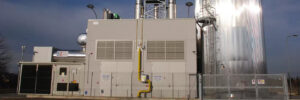
The plant’s production mix combines high-efficiency cogeneration with renewable and recovered heat sources. In 2021, a 147 kW heat pump was installed to recover waste heat from the cogeneration unit, further improving overall system efficiency.
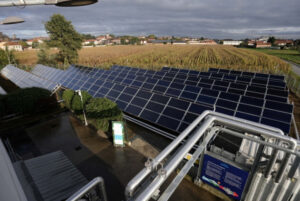
In addition, in 2025, the site integrated a solar district heating (SDH) system using the High Vacuum Flat Plate (HVFP) solar thermal technology. The Racconigi demonstration site represents a concrete example of how existing DH infrastructure can be progressively decarbonized through sector integration, heat recovery, and solar thermal technologies.
Solar District Heating (SDH) description
The project was developed by TVP Solar SA in collaboration with Engie Servizi S.p.A. at their District Heating Center. It represents a strategic effort to decarbonize the thermal energy supply of the City of Racconigi. The facility is fully integrated component of a complex energy hub that includes a High-Efficiency Cogeneration (CHP) unit, a HP, thermal storage tanks, and backup gas boilers. This complexity makes it an ideal candidate for the DIGISOLAR digital monitoring activities, as it requires precise control logic to balance multiple energy sources. The solar field is directly connected to a 350 m³ thermal storage tank, supplying hot water at 75°C.
Advanced Solar Technology
The solar field features TVP Solar’s proprietary MT-Power v4 HVFP collectors. Unlike standard flat-plate collectors, these are high-vacuum panels designed to operate efficiently at high temperatures (up to 180°C), making them perfectly suited for district heating networks that require consistent thermal delivery. The vacuum insulation minimizes heat loss, ensuring high performance even in cold climates or during periods of low ambient temperature, which is critical for the North-Italian location.
Technical Specifications
Collector Array: 525 MT-Power v4 high-vacuum flat plate (HVFP) collectors.
Total Aperture Area: 1029 m2 of net capturing surface.
Peak Thermal Power: 707 kWth (at a peak irradiance of 1000 W/m2).
Temperature Profile:
Field Inlet: 68°C
Field Outlet: 88°C
Design Operating Differential: 20°C
Flow Dynamics: A nominal operating flow rate of 31.16 m3/h. using water as the Heat Transfer Fluid (HTF).
Field Geometry: Optimized fixed-tilt installation at 35°C to maximize solar fraction across different seasons.
Performance: The system generates approximately 920 MWh of renewable heat annually.
Integration, Performance, and Digital Monitoring
The system is engineered to work in synergy with the primary energy production units. Solar energy is prioritized and fed directly into the district heating network or diverted to the thermal storage buffers when production exceeds immediate demand.
- Energy Yield: Dynamic simulations (TRNSYS) based on Meteonorm 8 datapredict an annual production of 917 MWh th /year.
- Fuel savings and CO2 emissions avoidance: On this basis, the SDH system saves around 122,000 m³ of natural gas and avoiding an additional 240 tonnes of CO₂ emissions per year
- System Synergy: The plant produces approximately 8GWh of thermal energy annually through cogeneration. The solar field provides a significant renewable contribution, reducing the runtime of backup integration generators which otherwise account for up to 14.2GWh of potential demand.
- Digital Innovation: Within the DIGISOLAR framework, the Racconigi field provides high-frequency operational data. This data is utilized to refine digital tools that optimize the “Solar + CHP” dispatching logic, ensuring that carbon-free solar energy is utilized to its maximum potential before activating fossil-fuel-based backups.
Location Data
- Site: Engie District Heating Center, Racconigi (CN), Italy.
- Coordinates: 44.77° N, 7.69° E.
The Racconigi demonstration site represents a concrete example of how existing DH infrastructure can be progressively decarbonized through sector integration, heat recovery, and solar thermal technologies.