
On 23 June 2026, the SUN-DT and DIGISOLAR projects hosted a joint webinar titled “Harnessing the Sun, Driven by Data: Digital Innovation for Solar Thermal Systems”, bringing together research and industry experts from the solar thermal community, along with representatives from the European Commission, to explore how digital tools can improve the design, operation, maintenance and competitiveness of solar thermal technologies.
Innovative solutions for smarter solar thermal systems
SUN-DT and DIGISOLAR are sister projects funded under the same Horizon Europe call “Digital tools for CSP and solar thermal plants”. SUN-DT focuses on digital innovation for concentrated solar power (CSP) tower plants, while DIGISOLAR addresses large-scale hybrid solar thermal systems for industrial process heat and district heating.
Webinar highlights
The event was moderated by Céline Suchet of the Association of European Renewable Energy Research Centers (EUREC) and Konstantinos Genikomsakis of the European Solar Thermal Electricity Association (ESTELA). Céline Suchet welcomed the audience and opened the webinar with an interactive Slido session, where participants identified performance optimisation and operation and control as the areas where digitalisation can bring the greatest value to solar thermal and CSP technologies, followed by digital twins and simulation. Participants also expressed a strong interest in solar thermal solutions for both industrial heat and district heating.
Marcelino Sánchez of CENER (National Renewable Energy Centre in Spain), coordinator of the SUN-DT project, presented “CSP 4.0: The Era of Intelligent Solar Energy – From Digitalization to Intelligent Energy Systems Based on SUN-DT project experience”. He framed CSP as an ideal testbed for next-generation intelligent renewable energy systems and highlighted the strategic value of CSP as a dispatchable renewable energy technology with thermal storage for electricity, industrial process heat, and green hydrogen production. He further emphasised that the value of digitalisation lies in connecting measurement, modelling and decision-making. To achieve this, SUN-DT will integrate advanced measurement and calibration tools for heliostats (HELIOSTATACC), a Digital Twin of the solar field and receiver (SUN-DTWIN), an energy management system for dispatch optimisation (D-OPT), and a predictive operation and maintenance (O&M) tool (PREDOM) into a unified platform, with the aim of improving performance, reducing O&M costs and enabling smarter plant operation.
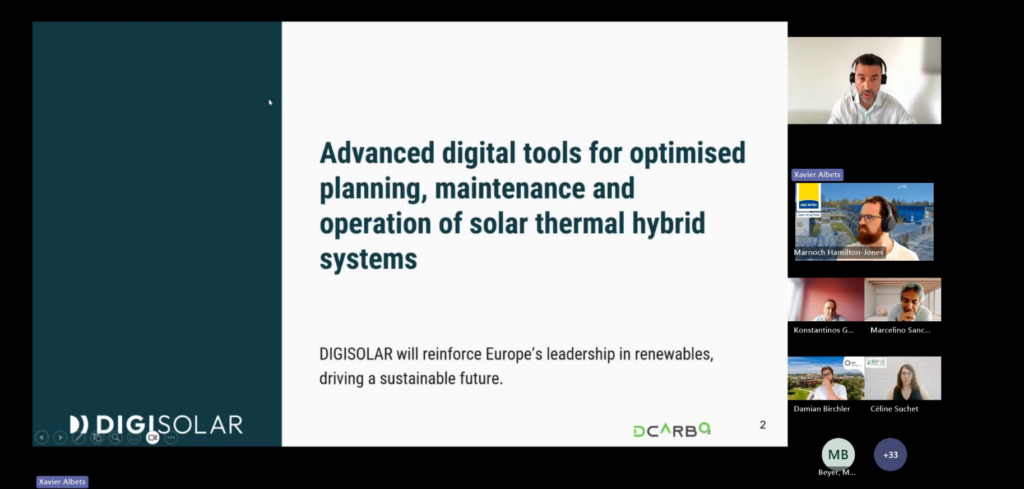
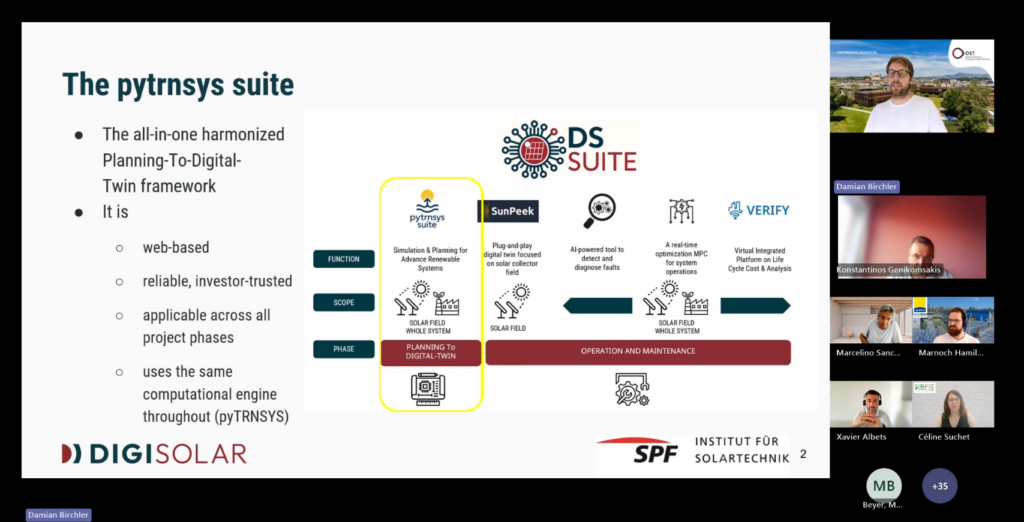
Xavier Albets-Chico of DCarbo Energy Consulting, coordinator of DIGISOLAR, introduced the project and its central digital platform, the DS Suite, which will support the planning, operation and optimisation of large-scale hybrid solar thermal systems. The DS Suite will integrate an all-in-one harmonised planning to digital twin at system level (Pytrnsys Suite), a digital twin focused on solar collector fields (SunPeek), an AI-powered tool for fault detection and diagnosis (FDD), an advanced energy management system for optimal dispatch (AEMS), and a life cycle analysis and life cycle costs analysis tool (VERIFY).
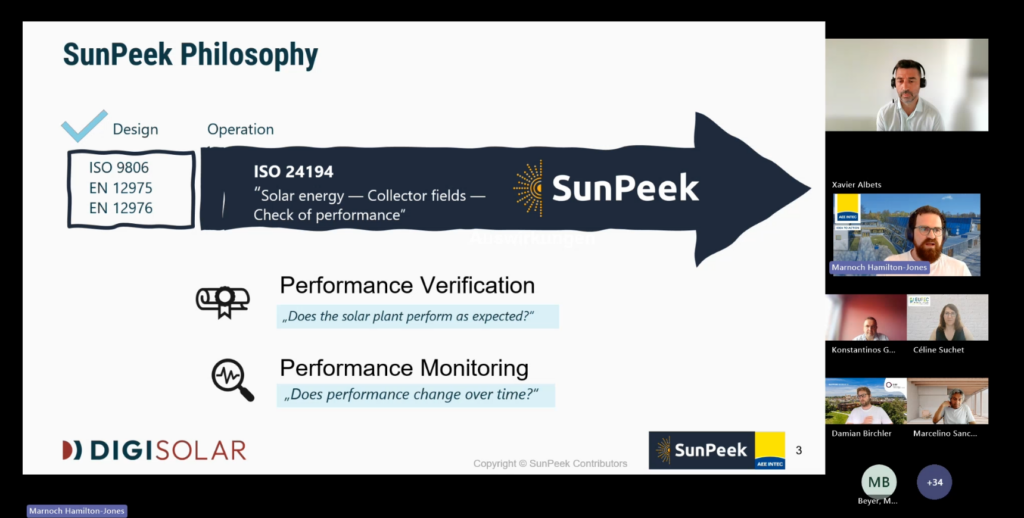
Subsequently, Marnoch Hamilton-Jones of the AEE Institute for Sustainable Energies presented SunPeek as a performance verification and monitoring tool for operating solar thermal plants, while Damian Birchler of the SPF Institute for Solar Technology at the OST Eastern Switzerland University of Applied Sciences gave an overview of the Pytrnsys Suite framework, demonstrating how it spans from pre-feasibility planning to operational digital twins.
Konstantinos Genikomsakis moderated the Q&A session, which evolved into an active technical exchange between the audience and speakers. A broader discussion addressed the barriers to scaling digital tools beyond project demonstrators. Speakers stressed that the barriers are not only technical. On the one hand, economic competitiveness, standardisation and ease of deployment remain key challenges. On the other hand, access restrictions, contractual arrangements, plant ownership structures and the involvement of financing actors can complicate validation in existing commercial plants. The discussion concluded that digital tools can help overcome these barriers by making solar thermal and CSP systems easier to design, monitor, optimise and finance.
A collaborative leap forward
The joint webinar marked an important first step in the collaboration between the two projects, highlighting their shared ambition to make solar thermal technologies smarter, more reliable and easier to integrate into Europe’s clean energy system.
The recording is available here and the presentations can be downloaded here.